Why a Falkland Islands expedition cruise South Georgia Antarctica needs real time in the Falklands
Most itineraries that combine the Falkland Islands, South Georgia and Antarctica compress the Falklands into a single day ashore. That rushed approach turns a living South Atlantic community into a checkbox on a long expedition cruise and quietly undercuts the value of your entire voyage. Give the islands south of the Antarctic Convergence two full days and the rest of your South Georgia and Antarctica expedition feels richer, calmer and more complete.
On a typical Falkland Islands expedition cruise South Georgia Antarctica route, you sail from the southernmost city of Ushuaia and reach the outer islands after one or two days at sea. Operators often schedule just one landing on an offshore island, then a quick call into Stanley before pushing south towards South Georgia, but that schedule leaves little space for weather, wildlife or genuine encounters with local people. Two exploration days in the Falklands, followed by two days at sea towards South Georgia, create a more humane rhythm and give your body and mind time to adapt to the ship.
The dataset for these combined voyages is clear about the trade off. Typical combo itineraries add around six extra days compared with a peninsula only Antarctica expedition, and at least two of those days should be spent ashore in the Falklands if you want a complete South Atlantic narrative rather than a stitched together highlight reel. When you look at a Falkland Islands expedition cruise South Georgia Antarctica brochure, ask not only about the price per person and the cabin category, but also how many days are actually scheduled in the islands south of the Antarctic Convergence.
Stanley as a town that lives, not a curiosity between sea days
Stanley, the capital of the Falkland Islands, is usually presented as a quaint stop between wilder days at sea. In reality it is a working South Atlantic town, with a British yet distinctly island identity that rewards anyone who walks beyond the souvenir shops near the pier. When your Falklands, South Georgia and Antarctica voyage gives you a full day in Stanley rather than a hurried half day, you start to feel that difference.
The streets feel like a small British seaside town, but the cathedral, the war memorials and the pubs tell a story that belongs to this latitude alone. Spend time in the museum, talk with residents about life this far south, and the later landings in Antarctica and South Georgia gain context because you have already met people whose lives are shaped by the same winds and the same sea. This is where the expedition team lectures about history and geopolitics suddenly connect with the café conversations you had over coffee and tea in town.
Voyages that rush Stanley often treat it as a logistics stop for a flight manifest or a quick refuelling call, but a more generous itinerary turns it into a cultural anchor for the whole expedition cruise. When you compare options, look for a Falkland Islands expedition cruise South Georgia Antarctica that offers a complete day in Stanley, not just a few hours between breakfast, lunch and the mandatory lifeboat drill. For fly sail readers used to skipping the Drake Passage, this is the South Atlantic equivalent of choosing a Drake free Antarctic fly cruise for the right reasons rather than simply to save time.
Outer islands, penguins and why the Falklands can outshine the Antarctic Peninsula for wildlife
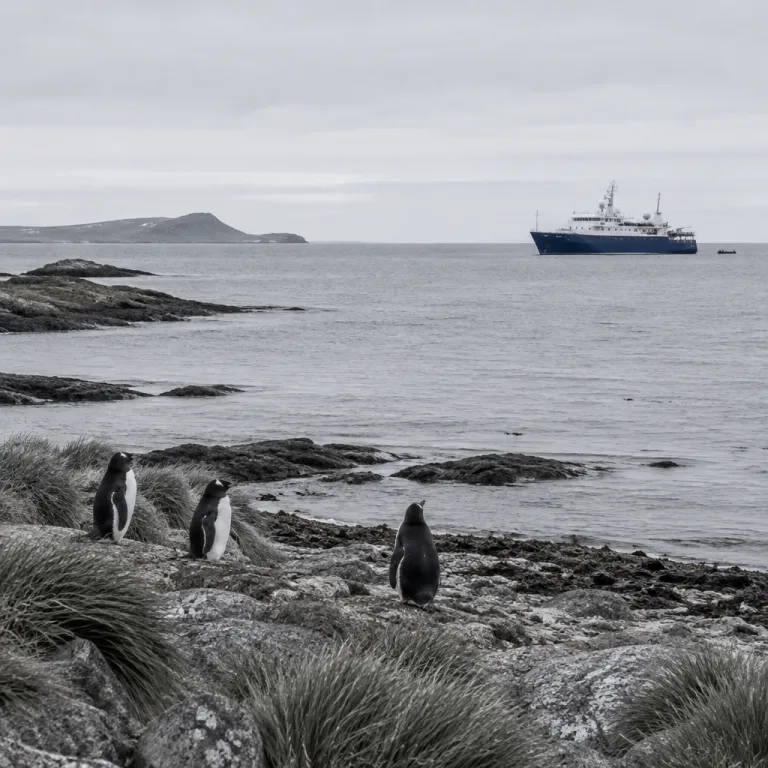
The offshore islands west and north of Stanley are where a Falkland Islands expedition cruise South Georgia Antarctica quietly earns its reputation among wildlife focused travelers. Land on West Point, Saunders or Carcass and you step into a world of black browed albatross, rockhopper penguins and swirling seabird colonies that feel more intimate than many Antarctic Peninsula sites. These landings are often gentler, with moorland walks and broad beaches that suit your first expedition day before the more demanding terrain of South Georgia.
Wildlife density can be startling. On a single walk you might pass nesting albatross, fur seals hauled out above the tide line and penguins commuting between burrows and sea, while the ship waits quietly offshore. For birders and photographers, two full days in the Falklands can deliver more varied wildlife than several days further south, especially if the weather cooperates and the expedition team can offer both morning and afternoon landings. The official guidance from one operator captures this balance clearly; “What wildlife seen in Falklands? Penguins, albatross, sea lions, fur seals”.
Because landing sites vary by season and swell, you should always check the indicative list of islands south of Stanley with your operator rather than fixating on a single landing name. Ask how many days at sea are scheduled between the Falklands and South Georgia, and whether the expedition cruise plan allows flexibility if a day is lost to weather. For readers who enjoy remote, wildlife heavy itineraries such as Weddell Sea pack ice voyages, the Falklands offer a temperate counterpart where the penguins often ignore you because you are the least interesting thing on the beach.
Choosing the right South Georgia and Antarctica expedition itinerary and ship
Not all Falkland Islands expedition cruise South Georgia Antarctica itineraries treat the Falklands with the same respect. Some large ship voyages schedule a token landing, while smaller expedition vessels with strong naturalist programmes tend to allocate two exploration days and accept the extra sea time. The difference shows in how relaxed the passengers feel by the time they reach South Georgia.
As an example, Aurora Expeditions has recently operated voyages of around twenty two days that combine the Falklands, South Georgia and the Antarctic Peninsula, with published lead in prices in the mid to high twenty thousand USD range per person in a twin cabin for future seasons. According to the company’s 2024–2026 brochures, these longer routes typically include multiple landings in the Falklands, several days along the South Georgia coast and a final section on the Antarctic Peninsula. Similar length itineraries from operators such as National Geographic Expeditions or other polar specialists often follow the same pattern; two days in the Falklands, two days at sea to South Georgia, then onward to the Antarctic Peninsula.
When comparing options, look beyond headline price and ask detailed questions. How many complete days are scheduled in the Falklands, and how many days at sea are built in as weather buffers between each region. Does the ship offer flexible dining such as early breakfast, lunch and then a more formal dinner service after landings, or is everything fixed around a rigid timetable that might clash with wildlife opportunities. For a deeper sense of how operators structure complex polar routes, it is worth reading long form itinerary breakdowns such as an elegant guide to planning polar minded travel before you commit to a specific cabin category.
Logistics, weather, and who should prioritise the Falklands on a long voyage south
Every Falkland Islands expedition cruise South Georgia Antarctica is at the mercy of weather, swell and daylight. Landings in the islands south of the Antarctic Convergence are generally easier than in Antarctica itself, but wind can still cancel a zodiac operation or turn a gentle beach into a surf line that challenges less confident guests. That is why itineraries that schedule two days in the Falklands offer better odds of at least one complete day ashore.
From a logistics perspective, you will usually embark in the southernmost city of Ushuaia and sail east into the South Atlantic, or occasionally join a voyage that links Buenos Aires, a domestic flight and then a charter to the port. Some itineraries reverse the direction and end in Punta Arenas after visiting South Georgia and the Antarctic Peninsula, which can be useful if you want to connect with onward flights north. In every case, the extra days at sea that come with including the Falklands should be seen as part of the experience rather than dead time, because they allow the expedition team to deliver lectures, wildlife spotting sessions on deck and quiet hours where you simply watch the sea change character as you move further south.
The islands particularly suit travelers who care about wildlife, history and the subtleties of place. Ornithologists, photographers and anyone with an interest in South Atlantic conflict history will find that two days in the Falklands add depth that no amount of time among king penguins in South Georgia can replace. If your primary goal is a fast Antarctica expedition focused on ice, and you are indifferent to cultural context or extra sea days, you can skip the Falklands with a clear conscience and choose a shorter route instead.
FAQ
Do I really need extra days at sea to include the Falklands
Yes, adding the Falkland Islands to a South Georgia and Antarctica expedition usually adds at least two extra days at sea plus the exploration days ashore. Those sea days are necessary because the distance between Ushuaia, the Falklands, South Georgia and the Antarctic Peninsula is significant. If you value a slower build up to the polar regions and more varied wildlife, those extra days generally feel worthwhile.
What kind of wildlife can I expect in the Falkland Islands compared with Antarctica
The Falklands offer dense colonies of rockhopper penguins, gentoo penguins, black browed albatross and other seabirds on the outer islands, often at closer range than many Antarctic Peninsula sites. You may also see sea lions and fur seals on beaches that are easier to access than some Antarctic landings. Antarctica delivers the grand ice scenery and larger penguin colonies, while the Falklands excel at mixed species encounters in a gentler setting.
Are landings in the Falklands suitable for first time expedition cruise travelers
Landings in the Falklands are generally considered a good introduction to expedition cruising. Beaches are often broad and gently sloping, and hikes tend to follow moorland paths rather than steep snow slopes. This makes the islands ideal for building confidence before more challenging zodiac operations in South Georgia and Antarctica.
How many days should I aim to spend in the Falklands on a combined itinerary
For a Falkland Islands expedition cruise South Georgia Antarctica, two full days in the Falklands is a strong benchmark. One day can work if the weather is perfect, but it leaves little margin for missed landings or delayed arrivals. Three days would be ideal for wildlife specialists, though only a minority of itineraries offer that much time.
Is the higher price of a longer Falklands, South Georgia and Antarctica voyage justified
Longer itineraries that include the Falklands, South Georgia and the Antarctic Peninsula cost more because they involve a greater duration, more fuel, higher staffing levels and more complex logistics. In return you gain a broader narrative arc, from a living South Atlantic town to some of the most remote wildlife sites on earth. For travelers who value depth over speed, that extra investment usually feels justified once they are back home.