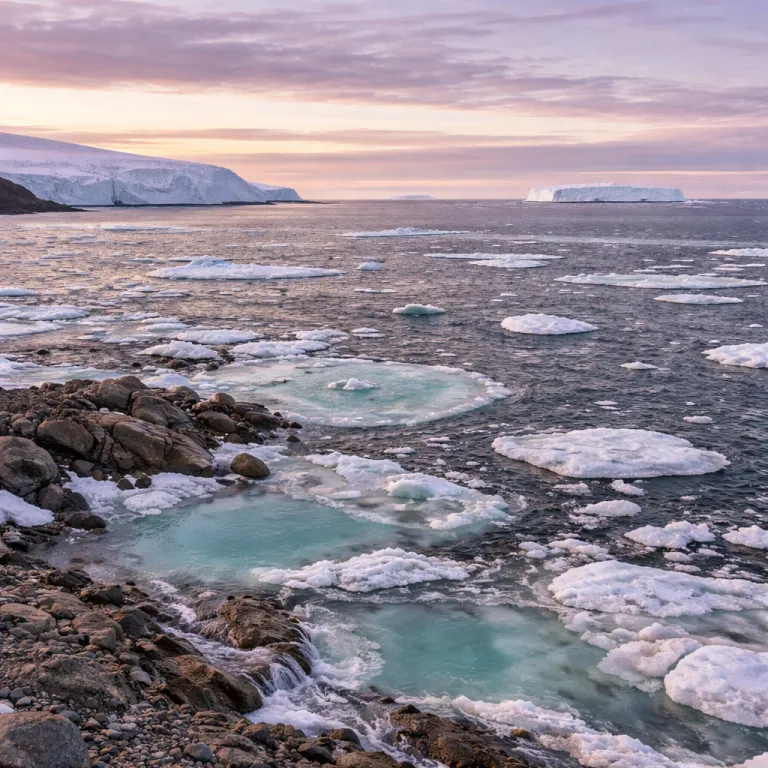
The Antarctic sea ice decline triple whammy explained
Antarctic sea ice is not just frozen water at the edge of the map. It is a mobile, fragile system that now sits at record low ice levels and is reshaping how, when, and where you travel. For couples planning a once in a lifetime voyage, understanding the recent Antarctic sea ice decline and its so called triple whammy is no longer optional but central to choosing an itinerary that still feels like exploration rather than climate chaos sightseeing.
A 2024 Science Advances study led by University of Southampton researchers (Naveira Garabato et al., DOI: 10.1126/sciadv.adk5514) identifies a three stage process behind the recent collapse in winter sea ice. First, stronger winds over the Southern Ocean began pulling warm Circumpolar Deep Water from the deep ocean toward the surface, quietly loading the system with extra heat. Then those winds mixed that heat into the upper ocean surface layers, especially along the fringes of East Antarctica, where the warm water started to erode the protective band of sea ice that once locked in the cold.
From around the same period, a feedback loop took hold that now makes it harder for the ice to bounce back to its previous extent. Darker open sea absorbs more solar heat than bright ice, so each summer minimum in sea ice cover exposes more ocean surface and accelerates warming. As Naveira Garabato explains in the paper’s media coverage, the “triple whammy” is the combination of deep ocean heat, strong winds, and a self reinforcing feedback loop that locks in thinner, less extensive sea ice, although the authors note that internal climate variability and limited observational records mean there is still uncertainty about how persistent this new regime will be.
Satellite observations from the National Snow and Ice Data Center and NASA show that the 2023 ice loss in the wider Antarctic region reached about 1.5 to 1.6 million square kilometres below the long term average, roughly the area of Greenland. NSIDC time series indicate that Antarctic sea ice extent has set record or near record lows in several recent years, including 2017, 2022, and 2023, even though individual seasons still fluctuate. That loss in Antarctic ice extent is not a blip but part of a long term pattern that climate models had not fully captured, and it is already altering the timing of pack ice around the Antarctic Peninsula. For travellers, this evolving Antarctic sea ice regime means shoulder seasons that are less predictable, more open water where there used to be consolidated floes, and a higher chance that your captain will be navigating through loose brash ice rather than the classic white horizon.

East versus West Antarctica and what it means for your route
East Antarctica and West Antarctica are now on different but converging paths, and that matters when you choose between a classic Antarctic Peninsula voyage and a deeper Southern Ocean crossing. In the east, the Science Advances work shows that ocean heat drawn from the deep ocean is the main driver, with warm water undercutting the sea ice and thinning the coastal ice sheet from below. In the west, especially along the Antarctic Peninsula, a warmer atmosphere and shifting wind patterns are amplifying climate change at the surface, pushing air temperatures above freezing more often and shortening the season of stable sea ice.
For travellers heading to the northernmost part of mainland Antarctica, the Antarctic Peninsula remains the most accessible gateway, with routes now carefully timed around a shorter window of reliable ice. Operators sailing this corridor, often profiled in guides to exploring the Antarctic Peninsula, are already adjusting departure dates to track the shifting summer minimum in sea ice extent. The same triple whammy of deep ocean heat, stronger winds, and feedback processes means that what used to be a relatively fixed calendar of pack ice, fast ice, and open leads has become a moving target that expedition leaders now reassess voyage by voyage, while still allowing for occasional years with more extensive ice when regional weather patterns briefly favour growth.
In East Antarctica, where the ocean surface is now measurably warmer in key sectors, the same three part mechanism is playing out with a different flavour. Here, the deep ocean heat that the University of Southampton team has mapped is eroding the edges of the ice sheet and changing the character of the Antarctic sea margin, with more frequent polynyas and thinner seasonal ice. For couples dreaming of a rare East Antarctica itinerary, that means a narrower band of years when the ice levels are still sufficient for classic scenes of emperor penguins on solid floes, before global warming and regional climate change push the system toward a new minimum state, even though the precise timing of that shift remains uncertain in current climate model projections.
The study’s authors and their international scientific partners in Southampton and beyond are clear that this is not just about the Antarctic itself but about the entire planet. As Professor Alberto Naveira Garabato warns in the Science Advances release, the Southern Ocean may be shifting from a stabiliser of the world’s climate to a powerful new driver of global warming, with Antarctic ice loss feeding back into sea level rise and altered weather patterns far from Antarctica. At the same time, the paper emphasises that model limitations, sparse observations in some regions, and natural variability mean that exact regional outcomes and timelines carry error bars. For travellers, that translates into a more urgent, time sensitive calculation about when to sail, which regions to prioritise, and how to balance the desire to witness this environment with the emissions footprint of reaching it.
Last chance timelines, wildlife realities, and how to travel now
The Antarctic sea ice decline and its triple whammy of drivers are already visible in wildlife statistics that cut through any romantic notion of an untouched white continent. Emperor penguin colonies in several parts of the Antarctic have suffered major breeding failures in recent seasons because the sea ice broke up before chicks had moulted, a consequence of unstable ice levels and shifting summer minimum dates. A 2023 study using satellite imagery (Fretwell and Trathan, Communications Earth & Environment, DOI: 10.1038/s43247-023-00927-x) documented widespread chick loss in the Bellingshausen Sea after early sea ice breakup, showing how quickly the Antarctic sea platform these birds rely on for raising young can vanish beneath them.
For couples planning a premium voyage, the phrase last chance travel now has a specific, science backed meaning rather than a marketing flourish. The combination of deep ocean heat, atmospheric warming, and the self reinforcing feedback loop described by the University of Southampton study means that some classic experiences, such as extensive fast ice landings or long zodiac cruises through dense pack ice, will become rarer on standard itineraries. Routes that once promised near guaranteed encounters with ice floes, sculpted bergs, and mirror calm leads may, within a long term planning horizon of a decade or two, offer more open sea and less of the frozen architecture that defines Antarctic travel, even though individual years may still deliver exceptional ice conditions when seasonal weather briefly favours growth.
That does not mean you should rush south without reflection; it means you should choose carefully, travel once and well, and work with operators who treat the Southern Ocean as a living climate system rather than a backdrop. Look for voyages that build in flexibility to chase the remaining ice, that time departures around regional sea ice minimum and maximum periods, and that are transparent about emissions and mitigation. If you are weighing polar options, pairing an Antarctic Peninsula voyage with a northern trip such as hiking in the Lofoten Islands under the midnight sun can spread your climate impact while still delivering high latitude immersion.
Reaching Antarctica from South America is itself part of the calculation, and refined routes from Chile to the white continent, such as those outlined in guides to travelling from Chile to Antarctica, now sit under the same climate change spotlight. Flying over the Drake Passage reduces time at sea but concentrates emissions, while sailing the full Southern Ocean crossing exposes you more directly to the changing sea state and ice extent that the triple whammy is driving. Either way, the evolving Antarctic sea ice regime has turned every high latitude itinerary into a front row seat on a planetary system in rapid transition, and the most responsible response is to travel with intent, stay longer, and let the experience change how you think about the rest of the planet.
Sources
Science Advances (Naveira Garabato et al. 2024, DOI: 10.1126/sciadv.adk5514); NASA satellite sea ice records; National Snow and Ice Data Center Antarctic sea ice extent datasets; Fretwell & Trathan 2023, Communications Earth & Environment, DOI: 10.1038/s43247-023-00927-x; University of Southampton climate and oceanography research.