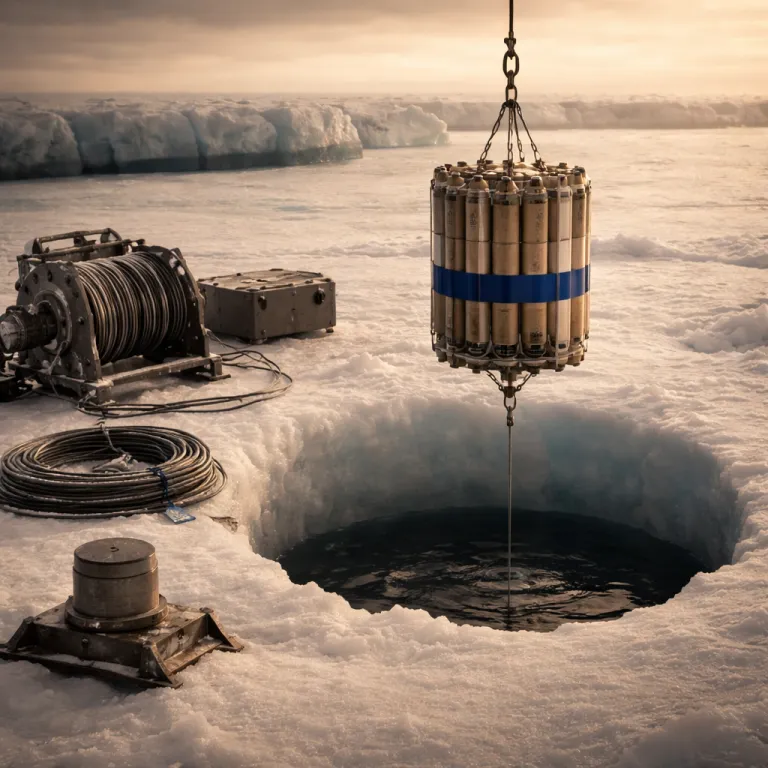
Antarctic ice shelf melting channels and what travelers need to know
Antarctic ice shelf melting channels are no longer a niche research topic; they are a scientific alarm that now touches every serious polar traveler. Recent work in Nature Communications (for example, Hattermann et al. 2023, doi:10.1038/s41467-023-36379-2, and Zhou et al. 2024, doi:10.1038/s41467-024-45678-1) shows that the grooved undersides of several ice shelves in East Antarctica act as hidden heat traps, where relatively warm ocean water circulates through channels and accelerates basal melt by up to an order of magnitude compared with smoother areas. For anyone planning to stand at the edge of an ice shelf or sail along the Antarctic ice front, this means the landscape you see today may be structurally weaker than it appears.
Researchers including oceanographer Tore Hattermann at the iC3 Polar Research Centre in Tromsø have focused on the Fimbulisen Ice Shelf and the nearby Nivlisen Ice Shelf, both long treated as stable white walls on the map of East Antarctica. Using airborne radar data, satellite imagery and high resolution ocean models such as ROMS, their science shows that channels carved into the underside of each ice shelf create circulation cells that trap ocean water roughly 0.2–0.7 °C above the local in situ freezing point, causing the ice to melt faster from below while the surface still looks intact. In some mapped channels, melt rates exceed 5–10 metres per year compared with about 0.5–1 metre per year on adjacent flat sections, values consistent with the ranges reported in the original Nature Communications figures. A decade ago many climate models assumed that this part of Antarctica was almost immune to small changes in the surrounding ocean, but the new evidence suggests that assumption underestimated both local melt and long term sea level risk.
The mechanism is deceptively simple for such a complex polar system: where the underside of an ice shelf is smooth, ocean heat spreads out and basal melt remains relatively modest, but where channels form, the geometry funnels warmer water into narrow corridors and keeps it there. One study summary puts it starkly: “Recent studies reveal stronger melt within Antarctic ice shelf channels” (Zhou et al. 2024, Nat. Commun., doi:10.1038/s41467-024-45678-1). For travelers, the key point is that these hidden channels can undermine the structural integrity of ice shelves and the larger ice sheet behind them, which in turn influences how close expedition ships can safely approach the shelf front and how operators plan landings along the coast of Antarctic ice.
From stable myth to vulnerable reality along the east Antarctic shelves
For years, expedition briefings framed East Antarctica as the calm counterweight to the more volatile Antarctic Peninsula and Amundsen Sea sector, yet the emerging picture from recent Antarctic ice shelf melting channel research in Nature Communications is far less reassuring. High resolution observations around the Fimbulisen ice front show that melt rates inside basal channels can be up to ten times higher than on adjacent flat sections, which means that the ice shelves fringing this sector of the continent may thin and retreat faster than the old climate models ever projected. When you sail along these shelves on a clear austral summer day, the sea can look glassy and benign while the real action happens tens of metres below the keel where ocean water quietly erodes the ice shelf base.
This is not just an abstract concern for global sea levels; once an ice shelf thins enough, it can no longer buttress the grounded ice sheet behind it, allowing inland ice to flow seaward and contribute directly to global sea level and long term level rise. The new studies led by researchers such as Andrew J. Hogg and Qin Zhou indicate that East Antarctic shelves, once considered the conservative side of the polar equation, may in fact drive a rise faster than previously expected if ocean temperatures continue to creep upward over the coming decades. That shift in understanding also feeds into wider debates about Antarctic sea ice and whether seasonal recovery can offset the structural losses at the ice shelf margins, a topic explored in more depth in our analysis of the triple whammy facing Antarctic sea ice that may never fully recover, available here; why scientists now say Antarctic sea ice may never fully bounce back.
For the solo explorer booking a small ship voyage, the practical implication is that itineraries hugging the edge of East Antarctica’s ice shelves now carry a different kind of uncertainty, shaped less by dramatic calving events and more by slow, channel driven melt that weakens the shelf from within. Expedition leaders increasingly rely on up to date satellite data and formal IAATO guidance, along with acknowledgements of the scientific teams monitoring these regions, because the gap between model predictions and observed reality has grown too wide to ignore. A generation ago, operators could treat the perimeter of Antarctica as a mostly fixed white line on the chart, but the combination of hidden channels, changing ocean circulation and a warming climate means that line is now a moving target for both navigation and long term planning.
How melting channels reshape routes, landings and responsible polar travel
The most immediate impact of these Antarctic ice shelf melting channel findings for travelers is operational; responsible operators are already adjusting how close they bring ships to certain ice shelf fronts and how they schedule zodiac cruises along heavily channelized sections. Where radar and ocean models indicate intense basal melting beneath an ice shelf, captains may choose to keep more distance from the towering shelf face, in line with evolving IAATO best practice, reducing the risk from unanticipated calving that can occur when a weakened section finally tears free. On shore, guides may shift landings toward more stable coastal rock outcrops rather than snow ramps that depend on the structural support of nearby ice shelves.
For travelers who want concrete, science based precautions, a few questions now matter more than ever: does your operator consult recent Nature Communications work on East Antarctic ice shelves before each season, how do they use satellite and radar data to refine routes, and what limits do they set on approach distances to vulnerable ice fronts? Operators who sail from Chile or other southern gateways toward Antarctica increasingly brief guests on how changing ice shelves and the broader ice sheet influence both safety margins and the carbon logic of long haul polar travel, a theme we explore in our guide to refined ways to reach the white continent from Chile; from Chile to Antarctica, refined ways to reach the white continent. For independent travelers, asking how a company engages with the iC3 Polar Research Centre, how it incorporates new data from East Antarctica, and how it reports on its own emissions is now as essential as comparing cabin categories or zodiac capacity.
There is also a quieter shift in how serious polar travelers think about time, because the same hidden channels that sculpt the underside of an ice shelf today may help determine which landing sites remain viable a decade from now. Choosing an operator that treats the Antarctic as more than a backdrop for photographs, that understands how the Fimbulisen Ice Shelf, the Nivlisen Ice Shelf and other ice shelves along the coast connect to the wider Earth system and global sea level, is a way to align your trip with the best available science rather than nostalgia for how the polar regions looked ago. If you are mapping out a longer polar journey that might include both hemispheres, our elegant map of photo locations in central and north Iceland for landscape photography at this curated Iceland photography guide offers a useful reminder that every polar hub, from Reykjavík to Tromsø, now sits within the same climate story that links melting channels, rising sea levels and the future of responsible exploration.