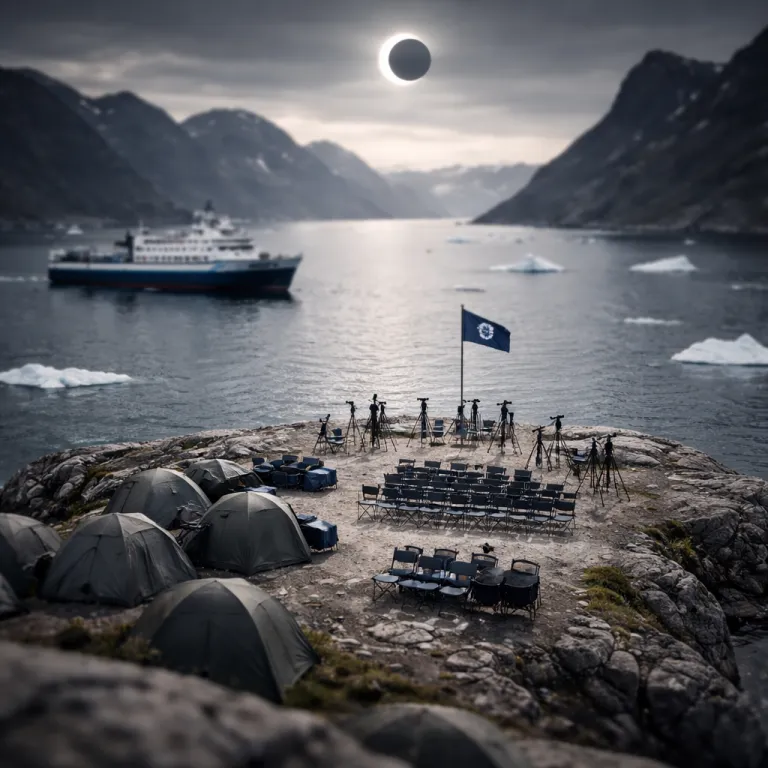
Planning a 2026 total solar eclipse Greenland cruise
Where Arctic totality meets navigable water
The path of the eclipse cuts a narrow corridor across Greenland’s east coast and adjacent Arctic waters. For couples weighing a 2026 total solar eclipse voyage by ship, the crucial detail is where that band overlaps reliably navigable sea ice margins near East Greenland. Expedition planners know that a few nautical miles off the Blosseville Coast can mean the difference between clear sky and a wall of cloud, based on long term satellite records and local pilot reports.
On a clear day the total solar phase will hang above a horizon of broken sea ice, with the ship positioned between the Denmark Strait weather systems and the fjord microclimates of Scoresby Sund, often written as Scoresby Sound. Major polar operators have announced plans for ships that will sail from Reykjavik Iceland or nearby ports to sit directly under totality, as outlined in their public itinerary previews and early marketing material. Many 2026 Greenland eclipse cruise itineraries are expected to route via Northeast Greenland and the Kong Oscar coastline, using the vast national park as a scenic backdrop rather than a hard landing objective, though final routes will remain weather and ice dependent.
For couples, the strategic question is not whether the solar eclipse will be visible somewhere over Greenland, but whether your chosen voyage can move if the forecast turns. A mobile ship based near East Greenland can reposition along the path of total solar alignment, while land based viewing in Nuuk or West Greenland locks you into whatever the sky delivers that day. The most resilient plans pair a 2026 eclipse-focused Greenland cruise with a flexible expedition team that can chase gaps in the cloud deck, guided by up to date satellite imagery, local ice reports and real time weather routing from experienced bridge officers.
Ship versus shore: cabins, waitlists and what you actually see
On the water, the 2026 total solar eclipse Greenland cruise proposition is simple yet expensive. You are paying for a polar expedition ship that can slide between sea ice floes, adjust course overnight and give guests a clean horizon line when the eclipse begins. Many couples are now asking whether that mobility is worth a cabin priced near 40 000 USD when a land based stay in Iceland costs a fraction of that outlay, especially if they are comfortable accepting a partial eclipse instead of full totality.
Ocean Albatros and similar vessels sailing from Reykjavik Iceland typically offer a mix of cabin categories, from compact single beds with a shared shower to balcony suites with a sofa bed, private bathroom and hair dryer. On a clear day, guests can step from their suite to the balcony and watch the solar corona bloom over East Greenland, then return inside before the expedition team calls for a zodiac cruise among icebergs. NASA and Timeanddate.com list the central date as 12 August 2026 and indicate that totality near many East Greenland coordinates will last a little over two minutes, so every second of that view matters, especially near the central line of the shadow.
To decide between ship and shore, couples can work through a simple checklist: first, confirm whether your plan aims for totality or accepts a partial eclipse; second, compare the flexibility of a moving vessel against a fixed hotel or lodge; third, weigh cabin comfort, balcony access and deck space against the cost of flights, gear and extra nights on land. If your preferred ship will sail close to its maximum of roughly 170 guests, consider a Plan B that pairs a shorter Iceland voyage with a land based viewing window, accepting that the team will not be able to move you as nimbly as a dedicated eclipse expert on a true expedition ship.
Wildlife, weather and whether this eclipse is worth it
Beyond the shadow itself, a 2026 total solar eclipse Greenland cruise folds in classic Arctic travel motifs. On a good day in Northeast Greenland you might watch musk oxen grazing on late summer tundra before the sky darkens, or cross the Denmark Strait under a bruised polar light that feels made for astronomy. Zodiac runs into Scoresby Sund or along the Blosseville Coast frame the solar spectacle with cathedral scale icebergs and the quiet that serious polar travelers prize.
What you wear and carry matters at these latitudes, even on a luxury leaning voyage with a strong expedition team. Think layered merino, a windproof shell, thin gloves for operating camera controls and eclipse glasses issued by the ship, plus a simple checklist that includes binoculars and spare batteries for any eclipse expert level photography. Pack as if you were heading into a national park backcountry hike, then remember that your cabin, suite or private balcony with a hot shower and hair dryer is only a few decks away, making it easier to warm up quickly after time on deck during totality.
The harder question is whether this specific solar eclipse justifies the cost when another total solar event will cross Spain and Morocco the following year. For couples who already love Arctic travel, the answer is usually yes, because the 2026 total solar eclipse Greenland cruise is not just about the eclipse but about seeing sea ice, Kong Oscar fjords and East Greenland’s wild coastline at a moment when climate data suggests long term change. For others, a calmer Mediterranean trip might be wiser, but they will miss the rare alignment of polar expedition, Arctic wildlife and a sky that turns to twilight in the middle of the day while your ship holds station in the heart of Scoresby Sound.
Key eclipse and cruise statistics
- Totality duration for many Greenland bound ships is approximately 2.1 to 2.2 minutes, long enough for a full corona view and horizon scan, according to standard eclipse predictions published by NASA and other astronomical authorities for the East Greenland track.
- Typical 2026 total solar eclipse Greenland cruise itineraries run for about 13 days, combining eclipse viewing with multiple Arctic shore landings and scenic cruising days.
- Expedition ships such as Ocean Albatros usually carry around 170 guests, keeping group sizes small enough for efficient zodiac operations and manageable deck space during totality.
Essential questions for planning your eclipse voyage
When is the 2026 total solar eclipse over Greenland and the Arctic?
The eclipse occurs in mid August, with the path of totality crossing parts of Greenland, Iceland and sections of northern Europe during a single day. NASA and other astronomical authorities list the central date as 12 August 2026, and expedition ships time their voyages so that they are already in East Greenland or adjacent Arctic waters when the shadow arrives. Your booking documents for any 2026 total solar eclipse Greenland cruise should clearly state the planned position and timing for totality, ideally with reference to predicted coordinates and local time windows for the ship’s intended station.
Where will the eclipse be visible during a Greenland cruise itinerary?
The path of totality crosses segments of East Greenland, including offshore areas near the Blosseville Coast, Scoresby Sund and parts of Northeast Greenland. Many polar expedition itineraries route through the Denmark Strait from Reykjavik Iceland, then into fjord systems such as Scoresby Sound to maximize viewing options and give guests a chance to see both sea ice and rugged coastline. Land based travelers in Iceland and West Greenland will see at least a partial solar eclipse, but only ships positioned directly under the path will deliver a full total solar experience with the corona fully exposed above the Arctic horizon.
How long will totality last on an expedition ship?
Most 2026 total solar eclipse Greenland cruise programs are targeting a totality window of just over two minutes, which aligns with published astronomical predictions for this event along the East Greenland track. That duration is long enough for guests to experience the rapid drop in light, the appearance of bright stars and planets, and the full solar corona above the Arctic horizon. Expedition teams rehearse the sequence so that every guest, whether in a balcony suite or on deck with an eclipse expert, can use those minutes without confusion and move safely between viewing areas.
Trusted sources for further polar eclipse planning
- NASA eclipse bulletins and interactive maps
- Timeanddate.com eclipse path visualizations
- Official press releases from polar cruise operators
